
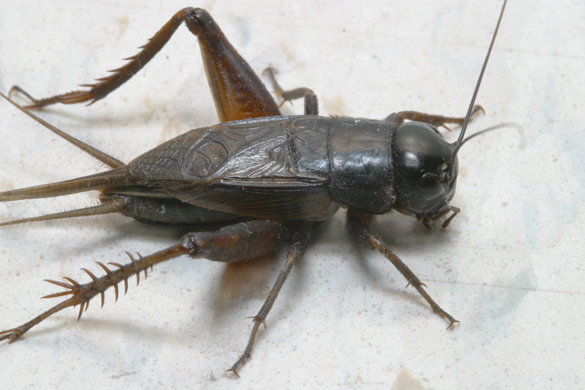
Masses of black field crickets are a common sight in late summer and fall in many parts of Texas.
Cricket outbreaks are one of the most predictable pest events of the year in most areas of Texas. Late summer and fall are when adult crickets become especially abundant around homes and commercial buildings. Although the cricket species associated with outbreaks in Texas have not been well-studied, most belong to the Gryllus assimilis complex, and are collectively referred to as black field crickets, or field crickets.
Biology
Field cricket eggs are laid in the fall, approximately two weeks after females mature and develop wings. Firm, bare soil sites are preferred for egg-laying. A single female cricket may lay from 150-400 eggs. Eggs remain in the soil throughout the winter and hatch the following spring.
Cricket nymphs can be identified by the incomplete development of the wings. Immature crickets require approximately three months to complete their development and become adults. Once the cricket reaches the adult stage it is capable of flight and mating. Cricket outbreaks occur when large numbers of nymphs complete their development and embark on nighttime mating flights.
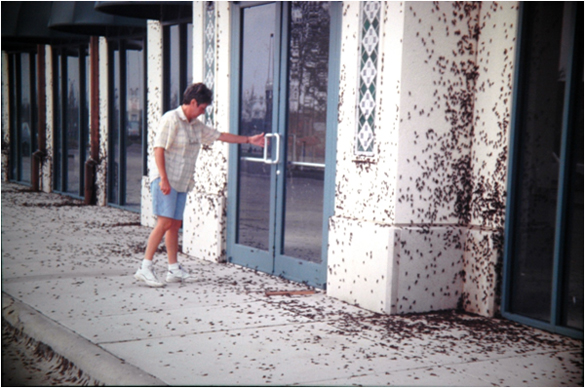
Fall cricket flights can be a cost for small businesses who lose customers and must pay for cleanup and disposal.
The largest cricket outbreaks seem to occur during years of dry springs and summers. The reason for cricket outbreaks under such conditions is not fully understood; however, less fungal disease among eggs and cricket nymphs may provide a partial explanation. Although crickets can be locally abundant in any year, numbers appear to be highest in August and September when a summer drought is broken by rainfall and cooler weather.
Damage
Field crickets are primarily outdoor insects, and as such are only accidental indoor invaders. Nevertheless, they can become a considerable household nuisance when abundant. Unlike house crickets (the species commonly sold in stores as pet food), field crickets do not breed indoors or establish permanent indoor infestations.
Indoors, crickets may damage clothing, drapes or wall coverings with staining from feces or vomitus, or by their feeding activities. Although crickets do not normally feed on fabrics, soiled clothing or clothes stained with perspiration may be damaged by crickets.
During severe outbreaks crickets can create an aesthetically unacceptable situation around places of business. Dead crickets quickly pile up, causing odors; and many people are repelled by the sight of large numbers of crickets on walls and sidewalks around offices and stores.
Control
Outdoor lighting is the most important single cause of severe cricket infestations around homes and commercial buildings. Buildings that are brightly lit at night are most likely to attract the largest numbers of crickets during the fall mating season. Reducing outdoor lights is the first, and most important, step in a cricket control program.
During cricket swarming season, outdoor lights should be turned off as early in the evening as practical, or should be replaced with lamps that are less attractive to insects. Low-pressure sodium vapor lamps and yellow incandescent “bug lights” are less attractive to crickets than standard incandescent, fluorescent, mercury vapor or halogen lights. Floodlights that illuminate homes or buildings, and which are not necessary for security purposes, should be turned off; or the lighting schedule should be restricted to a few hours each night.
All potential points of entry for crickets should be tightly sealed. Such sites include door thresholds, weep holes, soffits along the eaves of homes, windows, garage doors, etc. Crickets are especially likely to enter under doors at well-lighted entryways to buildings, as well as cracks and openings around outdoor lights, so check these areas carefully. Steel or brass wool may be stuffed in weep holes as temporary insect barriers, while allowing continued air circulation. Door sweeps consisting of nylon bristles or rubber seals can often be installed quickly and provide a dramatic reduction of crickets entering schools and other commercial buildings.
Crickets around building perimeters can be killed with any of several insecticidal baits and sprays. Baits are granular products that include a food that is tasty for crickets. They should be applied to ground covers and other areas where crickets are congregating next to buildings. Baits for crickets include products containing hydramethylnon (Maxforce® and Combat® granular ant and cricket baits), metaldehyde, carbaryl, and propoxur (Larva-Lur™).
Liquid insecticide sprays may be applied to outdoor sites around weep holes, doorways, windows and other cricket entryways. Indoor sprays are not very effective for field crickets and are not recommended. Effective liquid insecticides for homeowners include carbaryl, permethrin, cyfluthrin, and bifenthrin. Professionals should choose microencapsulated or wettable powder-formulated sprays on brick and concrete areas for longest lasting control.
Cricket control with insecticides should be considered as only a partial solution to cricket problems. Insecticides should be used in combination with reductions in outdoor lighting for best control. When crickets are drawn to lighted buildings at night, they will continue to cause problems, regardless of the amounts of insecticides used. The heaviest cricket mating flights usually last only 1-2 weeks, although crickets will continue to remain active for many weeks, until cold weather arrives.
Author
Michael Merchant, Ph.D., Professor and Extension Urban Entomologist, Texas AgriLife Extension Service, Dallas.