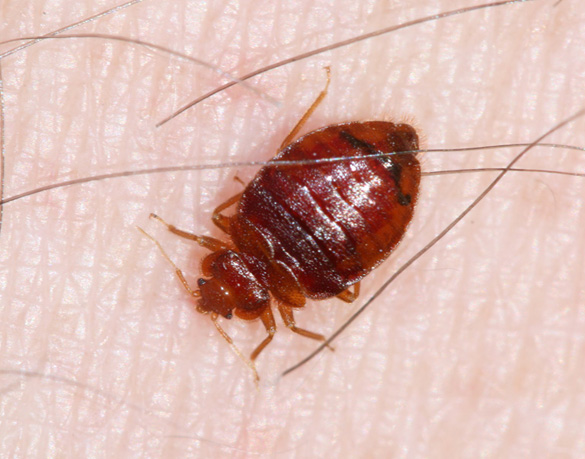
Bed bug, Cimex lectularis
Bed bugs are one of the most difficult pest problems to eradicate quickly. By far, the best solution for bed bugs is to hire a pest control company with experience successfully controlling bed bugs. Unfortunately, this can be expensive and beyond the means of many people. If you feel you cannot afford to hire a professional, and want to attempt do-it-yourself bed bug control, there are some things you can do. With diligence and patience and some hard work you have a fighting chance of getting rid of bed bugs in your home.
If you live in an apartment or condominium, it’s best to alert the property manager. A coordinated bed bug control effort using a pest control company is generally needed in such situations. Bed bugs readily move from apartment to apartment, with many people unaware that they have a problem. If one apartment is infested, adjoining units (left side, right side, above and below) should be assumed to be infested unless shown otherwise through inspection or monitoring. Simply asking tenants whether they have bed bugs is not enough. In one recent study only half of apartment residents whose homes were determined to have bed, bugs knew (or admitted) they had a bed bug problem.
Pesticides alone are not the answer to bed bugs. Most of the commonly used pesticides today, including professional products and consumer products advertised for control of bed bugs, are at best moderately effective at controlling these pests. Pesticides must be used with care for safety and with attention to proper application to work well. Aerosol “bug bombs” or “fumigators” are also mostly ineffective in eliminating bed bugs. Aerosol insecticides mainly kill insects that are exposed, and out of their hiding places, not those hidden behind baseboards, in cracks and crevices of the bed, under carpet edging and in walls.
Steps for do-it-yourself bed bug control
- Determine which rooms are infested. Bedrooms are the principal locations for bed bugs; however, any room where people sleep in the home may provide harborage for bed bugs. Living rooms with sofas and sofa beds are the next most common sites for bed bugs. Typically an infestation starts in one room and spreads slowly to other places where people sleep. The sooner you find and treat bed bugs the easier it will be to get rid of them. Wait too long and bed bugs may be found throughout your home.
- Don’t throw your bed away. It’s generally unnecessary to throw away beds or bedding. It is expensive to replace bedding, and chances are that any new mattresses, box springs or beds you bring into the home will quickly become re-infested. The money to replace a bed or mattress might better be spent on hiring a professional.
- Create a safe place to sleep. This is critical because staying in your own bed will reduce the risk of bed bugs spreading throughout your home. If you move to another room to sleep, the bed bugs will eventually follow. Then you’ll have bed bugs in multiple rooms. Make your bed a safe place to sleep by:
- Stripping and vacuuming the mattresses and box springs, and encasing them. Double bag your bedding and wash in hot water and dry for at least 30 minutes (discard the inner bag after putting bedding into the washer, as it could have bed bugs). After vacuuming suspected bed bugs from the bed, take your vacuum cleaner outdoors and remove and discard the bag. Purchase a good quality set of bed-bug-proof encasements for your mattresses and box springs. Bed bug-proof encasements are fabric sacks into which you slide your mattress or your box spring. The zippers on bed bug encasements are designed to be tight enough to prevent even the smallest life stages of the bed bugs from escaping. Also, good bed bug-proof encasements are woven to prevent bed bugs from biting you through the encasement. A good encasement will trap all bed bugs in the mattress and box spring inside, and will be smooth on the outside, providing few places for bed bugs to hide. Sears, Target, Walmart and other stores may sell bed bug-proof encasements, but these can also be purchased online. A good place to look for different brands and reviews of mattress encasements is Amazon.com (whether you buy there or at a local store). Go to http://www.amazon.com and search for “bed bug mattress protectors”.
- Killing all bed bugs on your bed frame and headboard. Normally this would be done by a pest control professional. Approximately 70% of all bed bugs in the typical infestation are located on the mattress, box spring and bed frame. You’ve encased the mattress and box spring and taken care of that problem. Now you have to make sure that your bed frame is bed bug free. Vacuuming alone won’t do this. Vacuuming can remove many bed bug adults and nymphs, but it isn’t very good at removing eggs. For this job you’ll need insecticide sprays and possibly dusts to treat every crevice and void in your bed. For insecticide spray and dust options see below. Remember that insecticides can be hazardous if you don’t follow label directions. Read the whole label before spraying or dusting. The label directions are the law and failure to follow the label not only puts you and your family at risk, it is against the law. Homemade sprays, by the way, are usually less safe than commercial insecticides. Stick with the legal stuff.
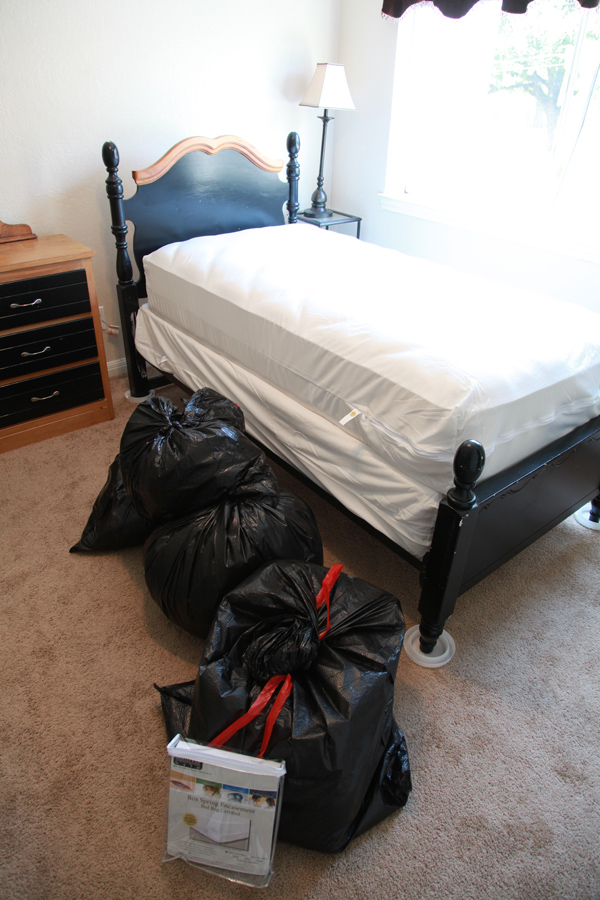
A bed that has been treated, encased and isolated from the rest of the room with Climbup® Interceptor cups is a safe place to sleep.
- Isolating your bed from the rest of the house. If you don’t use a bed, purchase a frame that gets your mattress off the floor and install bed bug interceptors under all feet of the bed frame to keep bed bugs off your bed while you are sleeping. Interceptors are special platforms or cups that are purchased to prevent bed bugs from climbing on to your bed. An interceptor can be as simple as a sticky card placed under a bed post (sticky and messy). Better are one of the commercial pitfall traps made specifically for this purpose. The Climbup™ Bed bug Interceptor and BlackOut BedBug Detector (Google them) are two such products sold online. Relatively inexpensive, these cups trap bed bugs attempting to climb (or exit) the bed. If you have encased your bedding, treated your bed frame thoroughly and installed interceptors, you will be instantly protected against bed bugs. Don’t take out your clean bedding or put it back on the bed until the bed has been treated (and dried) and encasements installed. And note that for this method to be effective, beds and bedding must not touch the floor, furniture or walls. This would provide bed bugs other ways to climb onto the bed and foil your defenses.
- Treat other areas in your home. This is perhaps the most challenging part of do-it-yourself bed bug control. If you catch an infestation early you may not need to do anything more than treat and isolate your bed as described above. But if an infestation has spread to other parts of the home, bed isolation may not be good enough. Here is where professional help may be needed, especially if you’re not up to moving furniture. Still determined? Here are some tips that may improve your chances of success:
- Prepare the room by separating treated from untreated furniture. This will involve moving all your furniture to one side of the infested room (Remember, you’ve already assessed which rooms you think are infested. You may not need to do this in every room). The process is important because if you treat half of the items in a room and leave other areas untreated, bed bugs may return to the previously treated areas from untreated sites. Take all clothes from drawers, infested closets, etc. and double bag them in clear plastic bags (clear bags are easier to see where things are). Also double bag all personal items (toys, papers, books, electronics, CDs, or anything that could serve as a hiding place for bed bugs) and set them aside until they can be carefully treated, cleaned or inspected.
- Systematically treat the room–all cracks and crevices around windows, outlets, blinds, pictures, posters and clocks on walls, baseboards, under edges of carpets and any other crevices or void areas in the room. Remember that immature bed bugs are very tiny. Dozens of bed bugs can hide in a recessed screw hole in a bed frame or dresser. Therefore it’s important that no hiding place be overlooked. Treatment can include vacuuming, but should not be limited to vacuuming only. Vacuums do not remove eggs, and will likely not remove all bed bugs from deeply infested cracks and crevices. Vacuums can remove many bed bugs from mattresses and the exterior of box springs (remember to immediately double-bag the vacuum bag after cleaning and dispose of outside in a trash can or dumpster). Sticky tape is another method of picking up bed bugs from furniture, walls, etc.
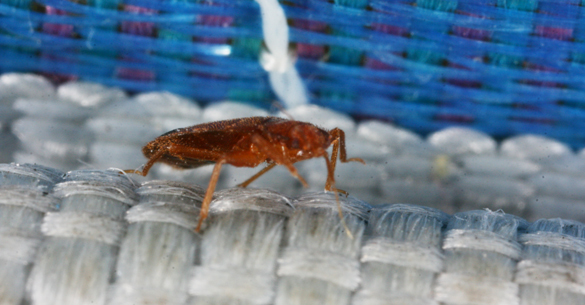
Bed bugs are flattened for hiding in cracks and crevices. This bed bug was hiding along the welting on the edge of a mattress.
- Systematically examine and treat all furniture (beds, bed frames, dressers, chairs, couches, night stands, etc.) following the same procedures and recommendations above. As a piece is treated it can be returned to the parts of the room that have been treated. Note that furniture should be taken apart, drawers and cushions removed in order to inspect and treat every nook and cranny. When treating upholstered furniture, pay attention to each welt, button and fold. You may wish to discard low-value, stuffed furniture that is infested and too difficult to treat. After spraying, return each article of furniture to the part of the room that has been treated. Do not reintroduce any furniture or other items to the treated room until they have been thoroughly cleaned, inspected or treated.
- Treat or isolate your bagged items. For washable items research shows that dry cleaning, washing in hot water for 30 minutes, or tumble drying for 30 minutes on high will kill all stages of bed bugs. Non-washables are a little trickier. Items that aren’t needed for a while can just be stored. It takes 2-5 months to kill bed bugs by isolating them in bags (the warmer the temperature, the shorter the survival time for starving bed bugs). Heating bags by placing in direct sunlight is one of the most effective methods during the warm summer months. Seven pounds of items placed in clear bags in direct sunlight on a 95 degree day will get hot enough to kill all bed bug life stages in one afternoon. Also, placing bagged items in a chest freezer (0 degrees F) for 8-10 hours is lethal for bed bugs and their eggs. Some toys may be disinfested by cleaning with hot soapy water and/or rubbing alcohol.
- Select and use insecticides safely. There are no magic sprays that kill bed bugs very well. Most commercial insecticides will kill bed bugs if applied carefully and directly to the insects and their hiding places. An exception is “Bug bombs”, or aerosol foggers. Foggers are mostly ineffective in controlling bed bugs. Because bed bugs hide in crevices and voids where aerosols do not penetrate, they are able to avoid contact with these insecticides. Their use is not recommended. Some of the products you may find helpful include:
- Desiccant dusts. Two low toxicity dusts with good effectiveness include silica aerogel and diatomaceous earth (DE). Both of these dusts are low risk to humans, and work by desiccating, or drying out, bed bugs that come in contact with it. Silica aerogel is, in some studies, superior for this purpose. It is sold under various trade names including Tri-Die™ and CimeXa™. Diatomaceous earth can also be effective. Look for DE for insect control–it is not the same product as diatomaceous earth used in swimming pool filters, which is dangerous to breath. Some pest control companies now use desiccant dusts extensively in bed bug control. These relatively inexpensive dust can be purchased online or in garden centers or hardware stores. Look for products labeled for indoor use and lightly dust all accessible crack, crevices and voids. A paint brush is useful for applying these dusts to seams and crevices in sofas and mattresses, along baseboards and inside drawers and dresssers.
- Low toxicity contact sprays like SteriFab™ or Bedlam® are likely to kill bed bugs only on contact. Alcohol- and soap-based sprays, are only partly effective. All of these products, once dry, are likely to provide no further control. Eggs will not be killed by alcohol-based sprays, so repeat treatments are usually needed. Be careful when using sprays containing alcohol because they may be flammable.
- Two plant oil-based products were recently evaluated and found surprisingly effective against bed bugs and their eggs. EcoRaider™ and Bed Bug Patrol™ received top ratings compared to other over the counter sprays in a Rutgers University study.
- Pyrethroid sprays are among the stronger and longer-lasting pesticides, but most bed bugs are resistant to these sprays to some degree. Special care should be taken when using pyrethroid sprays, especially when children are present. Only use pyrethroids in places indicated on the label. Do not spray electrical outlets with any type of liquid spray. Spraying should be done when children are not present, and all label directions followed carefully.
- Track your success. Interceptor cups under your bed posts are also one of the best ways of keeping track of your success with bed bug control. Check the cups regularly and empty into a trash bag or bucket of soapy water. You may even want to keep track of how many bed bugs you catch weekly so that you can track your success. Wipe out the interceptors and make sure they are clean. Some devices, like the Climbup Interceptor, require redusting with a very small amount of talcum powder to make them slippery again and reduce the bed bug’s chance of escape. Note that talc is not toxic to bed bugs, but simply makes it harder for them to climb out of the cup. The talc should be barely visible, and more is definitely not better.
A last warning
Pesticides should always be used with caution, and especially when used indoors. Never use a pesticide for bed bugs that does not bear clear directions stating that it can be used indoors. Never spray yourself, children or pets with a pesticide. And follow the label safety directions carefully. Pesticide labels contain directionsfor use that are not merely suggestions. Failure to follow directions exactly is illegal and can result in poor control and possible harm to yourself and family. For more information, see the EPA Consumer Alert on pesticides and bed bugs.
For more information
For more information about bed bugs, including their biology and how to recognize them, see other factsheets on the Citybugs bed bug page. The State of Michigan has also recently published a very detailed guide to Do-it-yourself bed bug control. Also, if you decide you need professional help, check out our advice onHow to Select a Bed Bug Control Professional, ENTO-033
Author
Michael Merchant, Ph.D., Professor and Extension Urban Entomologist, Texas A&M AgriLife Extension Service. Dallas.
Please note that I am unable respond to all questions posed in the comment section of this fact sheet. Before commenting, check to see whether your question is already addressed here, or in a link provided in this article.
